Drain The Ocean Hydrothermal vents on a drained ridge
Black smokers, animal cities, and the plumbing the 2009 special treats as a seafloor factory.
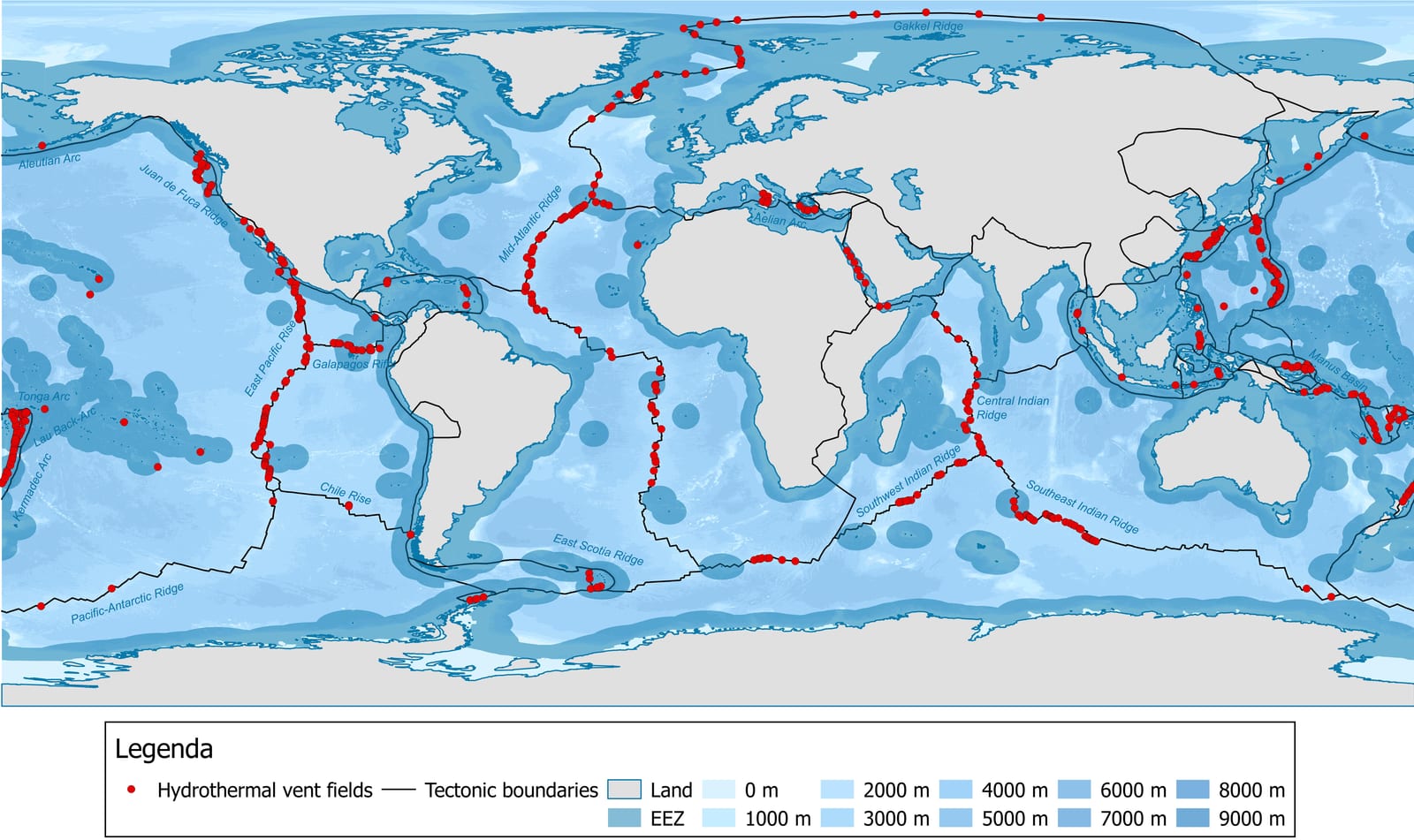
Hydrothermal vents are why a drained mid-ocean ridge is not just a mountain range. Seawater sinks into new crust, heats against magma, and returns as mineral-rich fluid that can exceed 350 °C at black smokers. The chimneys look like factories. The animals look like they should not be there. The 2009 Drain the Ocean special treats vents as a living exception to the “slow lane” of the abyss: a food web based on chemistry, not sunlight. This page is that exception. The ridge itself lives on mid-ocean ridge. The surrounding flat is abyssal plains.
A drain film can show a chimney field as a bump on a bathymetric grid. It cannot show the shimmer of 350-degree water, the red plume of a Riftia tubeworm, or the smell that submersible pilots joke about. Photographs and ROV video do that work. The National Geographic clip in the middle of this page — a 2026 Expedition: Saving Our Seas sequence on the most southerly deep-sea vent then known, filmed from Schmidt Ocean Institute’s ROV SuBastian — is the right medium for vents. Use CGI for the ridge. Use a dive for the smoker.
Where vents sit, and where they do not
Most high-temperature vents sit on or near spreading axes and back-arc basins. InterRidge-style compilations, including the distribution map on this page’s hero, plot confirmed and inferred fields along the global ridge system. They are not randomly sprinkled across trenches or canyons. A social post that drops a black smoker into Challenger Deep has changed geological chapters. Hadal trenches can have seeps and mud volcanoes; they are not the same plumbing as a ridge-crest smoker.
Lost City in the Atlantic is the useful counter-example. There, seawater reacts with mantle rocks to make alkaline, hydrogen-rich fluids and pale carbonate towers — a different chemistry from the classic sulfide chimney. The 2009 special’s “creature communities” beat is closer to East Pacific Rise and Mid-Atlantic black-smoker fauna: tubeworms, vent shrimp, mussels, microbes that oxidise hydrogen sulfide. Chemosynthesis is the word. Heat drives circulation; the food web runs on chemical energy. Do not say the animals “eat heat.”
Later Drain the Oceans hours sometimes garnish a wreck or a volcano sequence with a vent overlay. Treat that as television unless the episode is actually about a mapped field. The episode guide and the 2009 special are the two places this wiki expects vents to be a topic rather than a texture. Related specials that wander into undersea volcanoes are listed on related specials.
What mapping can and cannot resolve
A global GEBCO cell is far coarser than a chimney. Seabed 2030’s April 2026 coverage — 28.7% of the seafloor mapped to modern standards — still leaves most of the ridge as a smoothed prediction. Dedicated AUV and ROV surveys resolve individual smokers and animal clumps at centimetre to metre scale, the way MBARI has done on other deep habitats. The CGI drain method cannot invent that detail from a 15-arc-second grid. If a drain still shows a perfect row of chimneys, someone modelled them.
New fields keep appearing. Southern Ocean discoveries, Mariana back-arc vents, and Arctic ridge sites post-date the 2009 interviews with NOAA, the National Oceanography Centre, and Lamont-Doherty scientists. That is why new discoveries exists. A 2009 CGI vent city is a reconstruction of a then-known class of site, not a census. InterRidge and NOAA keep the living catalogues. This encyclopedia keeps the film grammar: vents belong on the ridge, in the dark, at pressure, with a food web that sunlight never meets.
Ice-age sea level does not expose vents. A 120–135 m drop (ice-age coasts) is a shelf story. Ridge-crest vents sit kilometres down. The what-if guide will not let a bathtub model park a tourist trail on a black smoker. Mean ocean depth is about 3,682 m; vents are a local hot anomaly on that hypsographic curve, not a new depth band.
Read this page after the ridge page and before the plains page. Then watch the 2009 special’s vent beat as plumbing plus biology, not as a wreck with unusual lighting. For the grids, open GEBCO and NOAA and Seabed 2030. For how the films light a bump they cannot visit, open how mapping works.
Sources: InterRidge hydrothermal-field compilations; 2009 special chapter lists and scientist affiliations; Schmidt Ocean / Nat Geo 2026 Southern Ocean vent clip; Seabed 2030 April 2026 coverage; Charette and Smith 2010 for mean depth context.
Frequently Asked Questions
Quick answers drawn from the pages on this wiki.
Are hydrothermal vents in trenches?
Classic black smokers sit on spreading ridges and some back-arc basins. Trenches are a different plate boundary. See mid-ocean ridge.
Can a drain film replace a vent dive?
No. CGI shows a bump. ROV video shows fluid, temperature, and animals. The clip on this page is the right medium.
Did the 2009 special cover vents?
Yes. Library chapter lists include deep-sea vents and creature communities. Details on the 2009 special.